Friday, 25 March 2016

Sarah Jones | Violette


Colony (Couch) (I)

Consulting Room (IV)

Consulting Room (VI)

Colony (Studio) (I)
Violette 

Sarah Jones first gained international attention in the late 1990's for her photographs taken in psychoanalysts consulting  rooms and of the couch lain on during analysis. Her later well-know studies of young women in domestic interiors and in urban park settings draw attention to the relationship played out between sitter, location, camera, photographer and viewer. This is further explored in her more recent works with the life model and in the drawing studio. Diptychs of horses, and of rose bushes on display in public gardens, both emerging from inky black backgrounds, refer to the viewing of early stereographic prints. Her Wild Rose works continue to explore this black ground as well as photography as an act of drawing. Jones's most recent still lives, Cabinet, isolate found objects collecting and arranged for the camera in her studio. 

"Looks at the themes and concerns rooted in the traditions of still life and portraiture that have remained constants in her photographs - the psychoanalytic couch, doubling, photographic black, cultivated nature, hair and the studio."

"Consider a photograph by Sarah Jones, its order and its emptiness, the subtlety of textures and details that unsettle the scene."

In Sarah's photographs there is a sense of human absence. Though there is no one in these photographs (shown above) the human presence lingers with the dips and curves within the sheets and couches; they have made their mark even if it is subtle they have had impact on the scenes before you. They look at the interiors of rooms which have a negative aura surrounding them; when you think about consulting rooms and such there is a drab feeling to them, this is captured in Sarah's work through the emptiness of the images, there is little there and the colours add a cold, saddened sense around it. Though Sarah has also done still life, and work with models these images stood out to me the most with the sense of isolation around them and how she has been able to portray the rooms for what they are rather than glamorising them and making them appear "pretty" as some rooms can have a darker feel to them. She is aware of the framing of the photos that she has taken, revealing only parts of the room to the viewers, this is something to think about with my work that I am creating; what I choose to have in the frame to reveal to the viewer, particularly when looking at exteriors/interiors of buildings as it could change the mood of the piece.


Reference:
Sarah Jones Violette book.

Thursday, 24 March 2016

Dan Holdsworth

Mirrors: cg 18c, 2014.
Mirrors: cg 06b, 2014.
Forms: cg 04, 2013.
California: 01, 2004.

California: 03, 2004.

Dan Holdsworth is known for taking photographs on the edge of things. He began his work in more anonymous hinterlands of urban sprawl such as road services that snake around bleak countryside and unkempt grassy verges beyond fenced-off civilisation. Dan photographs both during the day and night, often he is found to shoot in low lit scenes.

"The work of photographer Dan Holdsworth is most cogently addressed under the sign of hybridity, the interaction of heterogeneous elements that occurs with greatest intensity at the planet's borderlines. This hybridity is manifest in Holdsworth's fluid oscillation between commercial project and more identifiably artistic enterprises."

HYBRID - combining of elements.

The series California was taken at night, under low light conditions so a f1.8 lens would've been used to take these photographs. The surrounding around the main feature/focus point of the image tend to be dark; surrounding the subject in darkness but it doesn't seem to engulf it, only bring focus to them and the little details within the key subject rather than taking away from it. In 01 the dirt from the construction in front of the building is built up in a mound which acts as a leading line, drawing you towards what appears to be the doorway of the building, enchanting you to wanting to know what is inside, seeing what stage the interior has got to in comparison to the exterior. Along with this you can see lights coming from within the building however you are unable to see what its source is, adding curiosity to the piece. From the scaffolding attached to the building you can see that it is still under works, this alongside the darkness hiding from you where it is adds mystery to the piece, who's house is it? where is it being built? - are there other people living by? It leaves open many questions for the viewer, causing them to construct their own thoughts and stories to the image rather than having the answers given to them.
His series Mirrors and Forms look at close up shots of parts of the natural world, more so towards the  details in rocks/mountains and how with the use of flipping and mirroring the image in post-production. The textures and markings in the stone are key to the pieces, it adds depth to the images, they don't appear to be flat as you can see the rough texture with how areas dip and have chiselled away. Parts seem to have been hit or had something crash against them, though unable to tell what from, showing that it is crumbling. There is a wide tonal range within these pieces, rather than areas of the image blending to one it highlights smaller details that you wouldn't notice if the photograph was taken from further out.
I'm interested in how Dan has captured the more anonymous hinterlands and how there is that sense of there being a lack of civilisation, though humans have impacted on some of these scenes. Particularly with the series California as it more shows the meeting of manmade and the natural world and how we change the world with what we create, whereas his series Mirrors and Forms look at the natural world and the finer details within it, taking a step closer to the subject.


Sources:
images - http://www.danholdsworth.com/works/
http://www.saatchigallery.com/artists/dan_holdsworth_resources.htm
http://www.theguardian.com/becksfutures2001/story/0,,461935,00.html

First Visit | Shoot


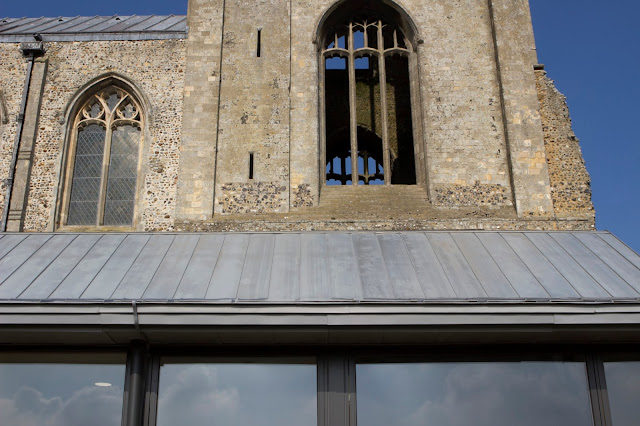
Leaflet given at the Abbey; has information about it while also going around the Abbey there were other bits of information about the place which gives insight to the building and the general history of the town and how it's part of a bigger part of history though many don't realise and many just see it as a small town that is being modernised.
My first visit to Wymondham I have mainly focused on exteriors while walking through the main of the town. Following the main town I came to the Abbey, while there I took photos of its exteriors and interiors. Would defiantly like to return and photograph the Abbey again and the cemetery and its other surroundings. I found it interesting as parts of the Abbey have been rebuilt and modernised which contrasts against the rest of the building.
Upon walking around the town there is a strong sense of older buildings (17th-19th century) seen in their structure, though you can see how parts are modernising and entwining in with features already there.

Saturday, 19 March 2016

Lewis Baltz


Lewis Baltz is known as one of the most prominent representatives of the New Topographics movement, the movement was seminal to the development of conceptual photography. The New Topographics movement was which began as a group of photographers including Lewis that shared a minimalist, detached and dispassionate aesthetic, while drawing on the contemporary art practice and rejecting the romanticism of traditional landscape photography. This is where Lewis's style of looking for typical, everyday things and photographing them as they are; his subject matter being the most ordinary things such as concrete walls, garages and metal fire escapes, but what all these photos had  was an absence of people. He is known to document side effects of industrial civilisation on landscapes, while he also focuses on places that lie outside the bounds of canonical reception, these photographs look at uncovering the correspondences between spacial forms that occur within the everyday world along with advanced forms which are found in art.
It is said that amongst his earliest works including The Prototype Works and The Tract Houses are what broke away from the mainstream traditions of photography, revealing what has become pronounced modernist references. 
I am keen on Lewis Baltz photographs which have been captured the exteriors of buildings, a majority of these are close up, allowing you to only have part of the building/wall to be in frame though others are taken from further out allowing you to see its surroundings. When looking at these images that he has taken you can relate them to the buildings that you have seen as they are mundane and typical sights that you would see on an everyday basis. The photographs tends to focus on the shapes and what they are actually of rather than romanticising it for what it is not; with the approach he has gone for it makes you look at the subject for what it is and look at finer details of what makes up buildings and such.

Monday, 14 March 2016

What makes a photograph?

What makes a photograph? Can it still be considered yours if you didn't physically take the photo?
There are many discussions and thoughts on what makes a photograph your own. There isn't a defined right or wrong, only a personal opinion really having your own reasoning for your view of the matter.
With the brief given it states that we can source images/files and such from the internet for our project. Alongside this with the theme being space and place, for most the initial thought is of landscapes, now this isn't always the case as you can look at exteriors and interiors of a place, you don't need to have wide shots viewing a whole scene, you can have close ups focusing in on little details of an area looking at say, how it can change. This in mind, looking at exteriors one could take google maps, select the street view mode perhaps and look and selected buildings without having to visit the place and photograph them yourself. However not always does google maps show you what the place looks like currently, from looking at places myself I have found that they aren't all up-to-date though they can show you a span from when they took the first views at those places to the most recent that they have, showing you how they have changed over time. Could take screenshots of these views from the same angles then go to my location and photograph it from the same angle, as close as possible to show how a building changes over time and you see the ageing of its exteriors and how it can become more worn, however it could stay similar and the things around it have changed. It's possible to mould what has already been created to add to your own work.

Tutorial | first


In our first small group tutorial we discussed our locations that we had received for this project and our first initial ideas. As I have researched my location and found that a high percentage of the buildings in the town are from the 17th-19th century I would like to look into the interiors and exteriors of the buildings, taking from bigger scenes looking at smaller finer details, rather than looking at the overall scene as I think with these buildings if I were to have wide view shots that you wouldn't see details in them so much, however once I go to my location later in the week I will have a better understanding and will be able to take some photographs based upon this.


Wednesday, 9 March 2016

Mishka Henner


I am looking at Mishka Henner's projects Dutch Landscapes and The Fields, he hasn't taken the photographs himself but sourced them from google maps and satellites that have orbited the Earth, however despite this he has manipulated them. I personally am captured by the patterns within these aerial shots taken and the distortion of part of an image and is an interesting concept to look at, also within my own work when i take my photographs and do post-production on them it is something to consider and keep in mind for if doing something like this would link in with my own work.

In Dutch Landscapes the scenes that are captured and presented to the viewers are much similar to landscapes that we see around us, only taken from a different vantage point, this makes it more appealing looking from a different perspective than one you would usually view landscapes from as they are all aerial shots looking directly down at the scene. 
"Seen from the distant gaze of Earth's orbiting satellites, the result is a landscape unlike any other; one in which polygons recently imposed on the landscape to protect the country from an imagined human menace bear more than a passing resemblance to a physical landscape designed to combat a very real and constant natural threat."
There are patterns seen in the landscapes and repetition of lines, leading your gaze around the image. The blurred/pixelated areas block colours, bringing out key colours within that area which you cannot  see, some of these you can tell would be there but others you wouldn't have noticed so much if it were not to be pixelated. Within the images you can see the joins of fields and how they stop when they meet buildings, though the images appear quite flat there is a sense of knowing things would be higher than others and the differ in levels is subtle, more focusing on the patterns in the work and the textures with how areas in the piece differ to one another to make the overall piece, contrasting harmoniously together.

The Fields is a project based on US oil fields that were photographed by satellites orbiting Earth, with each print that Mishka has produced is composed of hundreds of high-resolution satellite images of each location stitched together which shows intricate details. From looking at these pieces you can't see that they are constructed by a large amount of images, it looks like one large image so there is the feeling that the images that he took to manipulate together where very close up shots capturing little details with each area within this scene so that al things within the piece are in focus. Mishka could've recreated the view to being similar to what it actually is or he could've changed it around for it to look more visually appealing to the eye with the patterns and lines in the pieces. However if you didn't know it was more than one image edited together when looking at the image you wouldn't think about that, focusing on the structures, textures and repetitions through lines and patterns that are seen in the oil fields.


sources:
http://mishkahenner.com/filter/works/The-Fields
http://mishkahenner.com/filter/works/Dutch-Landscapes